By Ben Neunstoecklin, PhD
Director, Commercial Development
|
Increasing molecule complexity, growing clinical demand, and rising cost pressures are driving intensification of CDMO industry processes. Lonza’s OptiALTO® intensified fed-batch (IFB) platform offers a practical way to increase productivity through higher titers, improved asset utilization, and more flexible supply strategies across the molecule lifecycle without compromising quality or scalability. “This is a real late-phase opportunity to improve CoGs when they become most important in the product’s life cycle. Ideal to be combined with tech transfer and scale-up transition.” Ben Neunstoecklin |
Industry intensification trends reach CDMOs as mammalian manufacturing matures
Improving manufacturing productivity has become a strategic priority across the biopharmaceutical industry, particularly as new and increasingly complex molecules are fundamentally changing technological and operational approaches to drug development. Against this backdrop, Lonza enables customers to leverage our extensive process know-how and our OptiALTO® platform using N-1 perfusion reactors for seed train intensification. The Lonza OptiALTO® platform optimizes biologics manufacturing costs by reducing production timelines, increasing cell density, increasing protein titers and improving the overall cost of goods (CoG). Customized intensification solutions are tailored to client-specific needs and can offer significant benefits by optimizing production economics, process control, and capacity utilization and meeting the growing demand for high-quality biotherapeutics.
What is an intensified fed-batch process?
Traditional fed-batch processes have been the backbone of biologics manufacturing for decades—and for good reason. They are well understood, robust, and broadly transferable. However, as pipeline complexity grows and cost pressures appear earlier in development as well as throughout the life cycle, classic scale-up alone does not always deliver the efficiency customers need. Lonza’s OptiALTO® platform addresses this challenge by rethinking how productivity is generated within the upstream process:
- Perfusion technology in the N-1 production stage is used to expand cells to very high viable cell concentrations.
- These cells are transferred into the production bioreactor (N-Stage) at much higher densities than in traditional fed-batch operations.
- From there, the production bioreactor is operated in fed-batch mode, but achieves the highest cell densities earlier and longer, hence producing more product in the same time.
- Advanced process analytical technology (PAT), such as Raman-based feed control, enables real-time, automated adjustment of nutrient delivery.
Importantly, IFB keeps the original cell biology and preserves product quality while increasing overall output per batch.
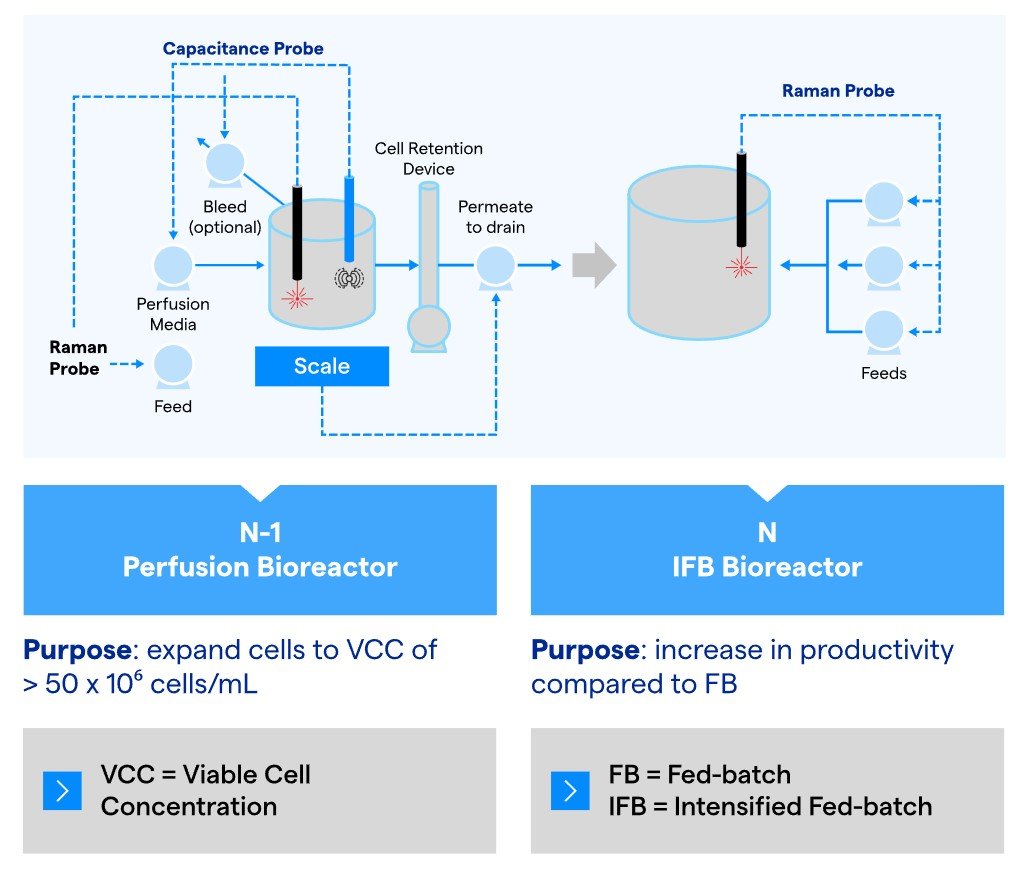
Figure 1: Scheme of Lonza’s OptiALTO® platform: Using an intensified fed-batch bioreactor with perfusion reactor seed train
These improvements have tangible manufacturing implications. Higher titers and shorter N-stage occupancy translate into improved asset utilization and, at commercial scale, meaningful reductions in biologics manufacturing cost. Current data suggests a significant CoGs reduction potential at 1kL bioreactor assets, with further potential benefits at larger volumes.
What are the benefits of the OptiALTO® platform?
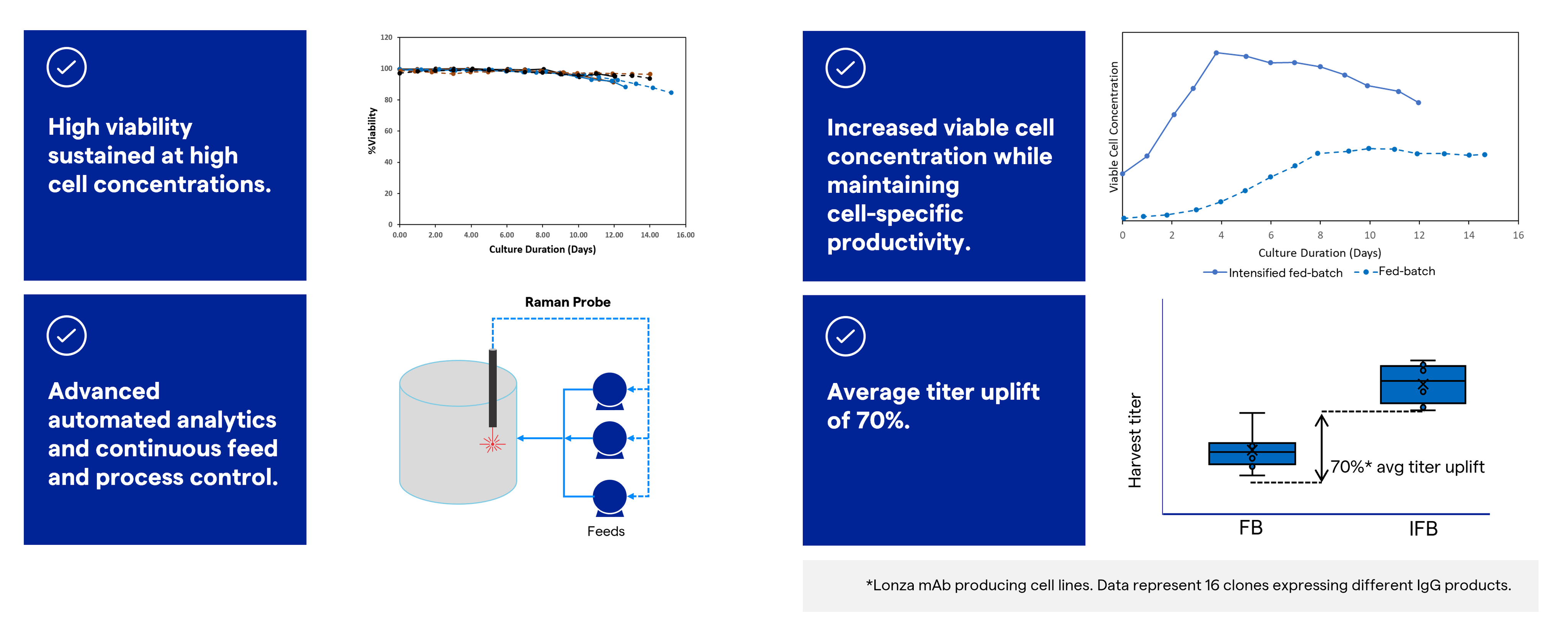
At its core, intensified fed-batch approaches are about control and consistency at higher inoculation cell densities—and the data shows that this control translates directly into performance. Lonza’s OptiALTO® platform performance has been evaluated across multiple monoclonal antibody–producing cell lines and IgG formats, using a standardized process architecture.
Key observations include:
- High viability sustained at elevated cell densities, indicating that productivity gains are not driven by cell stress.
- Increased viable cell concentration while maintaining cell-specific productivity, preserving a predictable process.
- Advanced automated analytics and continuous feed control, reducing operator dependency and offline testing.
- Average titer uplift of ~70%, with titers exceeding 10.5 g/L.
When is the right time to consider process intensification?
Process intensification is not a one-size-fits-all solution, nor does it need to be adopted at the beginning of every molecule's development. Its value depends on what a customer needs most at a given time during the molecule life cycle. Considerations to be explored are such as speed versus certainty, supply security, cost efficiency, or long-term flexibility. The OptiALTO® platform can support different objectives across the molecule lifecycle when applied intentionally.
Early development and pre-clinical stages
At early stages, the primary focus is usually speed to clinic and process flexibility, not maximum economic optimization. The OptiALTO® platform can be particularly valuable when:
- Clinical material demand is high relative to available scale
- Molecules are hard to express and struggle to reach target titers.
- Programs need early risk reduction without committing to large-scale infrastructure
At this stage, customers may choose either a conventional fed-batch process or an intensified approach. Importantly, early process design can already account for future intensification readiness, ensuring that today’s decisions do not limit tomorrow’s options.
Late clinical development (Pre‑Phase 3)
As programs move toward pivotal trials, priorities begin to shift. Supply reliability, launch readiness, and emerging cost pressures become more prominent. This phase is often an ideal inflection point to:
- Assess whether conversion to Lonza’s OptiALTO® platform can improve productivity and cost of goods before commercial launch
- Confirm process robustness and scalability across manufacturing sites
- Reduce downstream risk by stabilizing upstream performance earlier rather than later
Here, intensification becomes a strategic choice, not a reactive response—allowing customers to enter commercialization with a process designed for longevity.
Commercial manufacturing and lifecycle management
For commercial products, intensified fed-batch plays a key role in second-generation process strategies. Typical objectives at this stage include:
- Reducing cost of goods without increasing operational complexity or risk
- Supporting scale-out or scale-up in response to evolving market demand
- Enabling multi-site manufacturing to strengthen supply security and business continuity
Because Lonza’s OptiALTO® platform is deployed across multiple scales and locations, customers can apply process intensification as part of a harmonized global manufacturing strategy, while retaining the flexibility to adapt as product or market demand changes.
Evolving with customer needs
Utilizing our OptiALTO® platform for manufacturing is not about replacing proven fed-batch processes, but about offering customers an extension to their performance envelope. By combining high-density cell culture, advanced analytics, and a platform-based approach, the OptiALTO® platform allows Lonza to generate more value from existing assets for our customers and drive down manufacturing CoGs, while maintaining the robustness required for global biologics manufacturing. Lonza has installed OptiALTO® platform capabilities globally across all relevant scales—from lab and pilot to mid- and large-scale manufacturing—enabling consistent, end-to-end support throughout the molecule lifecycle.
For me, the most rewarding aspect is seeing process intensification help enable molecules that might otherwise struggle to reach market viability, supporting customers with confidence at every stage of development and commercialization, and being able to offer them new, exciting manufacturing solutions when the time for their second-generation process arrives.
About the author:
Ben Neunstoecklin is a Commercial Development Director at Lonza, with over 17 years of experience in the pharmaceutical and consumer health industries. In his past he has held strategic and operational roles at Merck Serono, Novartis, and Bayer, with broad experience in R&D, operations, and supply chain. Ben earned his PhD in biochemical engineering from ETH Zurich and is passionate about mammalian bioprocesses, particularly intensified and continuous manufacturing.
|
|
Are you constrained by a process developed with speed rather than cost efficiency?If you would like to leverage late phase or post-launch cost efficiencies and you need support and guidance, reach out to a member of our team to learn how we can support your project’s journey. |

 |