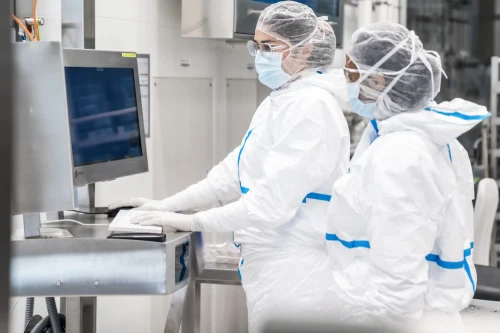
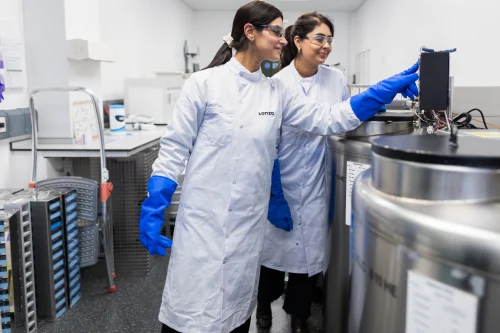
Every day in a development lab unfolds through a series of routine checks that keep experiments moving and data flowing. Glucose monitoring is a perfect example: a quick measurement that, when repeated across many cultures, becomes a meaningful though laborious part of the workload. That realization became the starting point for a collaborative effort between the R&D and Operational teams to rethink how this routine measurement could be managed more effectively.
Precise monitoring of culture conditions is essential in the development of biologics, especially when working with mammalian cell systems such as CHO cells. Glucose plays a critical role in maintaining healthy cell growth and achieving consistent protein production. Historically, glucose measurements in small‑scale bioreactor systems have been performed manually. While this approach is proven and reliable, it requires frequent sampling and considerable operator time. With dozens of miniature bioreactors often running in parallel, this manual work adds up quickly and can ultimately limit how much experimental complexity teams can reasonably explore.
This challenge was not about accuracy; manual measurements are accurate – but about readdressing the potential scale and efficiency. Within R&D, we saw an opportunity to explore whether part of this routine monitoring could be supported through a data‑driven approach. We wanted to see if we could maintain the same level of scientific confidence while leveraging machine learning (ML) to confidently reduce some of the repetitive, manual steps.
Building the Predictive Model: Using the Data We Already Generate
Through discussions with our colleagues, we saw the potential in the rich process data already being collected. We asked: Could data-driven estimates be accurate and reliable enough to safely reduce sampling frequency by augmenting, not replacing, the existing workflow?
The project began by assembling historical process data from multiple small‑scale experiments. These data included routine measurements and flow rate information used to monitor and control culture conditions.
Using this dataset, we developed a ML model capable of predicting glucose levels directly from standard process signals. During evaluation, the model achieved an average deviation of ±1.78 mmol/L. This level of accuracy suggested that the model could provide stable and reasonable estimates across a variety of cell culture conditions.
The next step was to test whether using model-predicted glucose values to guide feeding would affect overall culture performance. Side-by-side trials were conducted in R&D, comparing vessels fed based on measured glucose values with vessels fed based on predictions. We looked at standard outputs: growth, viability, titer and lactate.
The results gave the team confidence that the predictive approach could be safely tested beyond R&D and that it could do so without compromising scientific rigor and product-relevant outcomes.
Scaling Up Through Partnership: Validation with Operations
To understand how the model would perform under real process conditions, we built a close partnership with a team across R&D Expression Systems and Operations. Joint testing involved matched vessels in which one set was controlled using model‑based predictions and the other using manual glucose measurements.
The outcome mirrored the initial R&D trials: culture performance remained consistent between the two approaches. This collaborative validation was essential. By validating the tool in the environments where robustness and reliability are paramount, the cross-functional team achieved the approach was not just scientifically sound but operationally fit.
Building to Last: A Sustainable Cloud‑Based Workflow
Apart from accuracy, a successful model needs a path to sustainable use. To that end, the model was embedded in a cloud‑based Operationalize machine learning (MLOps) pipeline, so it's automatically trained, deployed, monitored and updated through cloud infrastructure. At a high level, this means the model is supported by an automated, cloud‑based workflow that handles the routine steps needed to keep it reliable over time. This enabled consistent data processing, model versioning, automated retraining, and controlled deployment.
The infrastructure matters because it keeps the model current and auditable. As new process data becomes available, the pipeline can retrain and evaluate updated versions under governance controls, ensuring that performance is monitored and that changes are deliberate. Just as importantly, the process is collaborative: experimental teams, digital specialists, and operations colleagues align on criteria for updates and deployment, maintaining the focus on safe, responsible integration.
Delivering Value to Teams, Customers and Patients
Following successful verification, the predictive monitoring approach is now in use at the 15 mL process‑development scale within the Integrated Biologics network. Current usage shows it can help avoid more than 1,200 hours of manual glucose sampling per year across sites. This time can be used to focus on answering higher-order scientific questions rather than routine lab work.
The impact, however, goes beyond hours saved. By demonstrating that ML can be integrated responsibly into early bioprocess development, this project establishes a blueprint for future data-driven tools and represents a meaningful step in our journey toward more automated and data-driven bioprocessing. By embedding ML into standard workflows, we are helping pave the way for higher-throughput development and efficient use of experimental data.
For customers, this translates into more efficient development cycles and a lower risk of contamination or sampling-related disturbances. Ultimately, building digital and ML capabilities helps the industry accelerate development in the future, allowing therapies to reach patients faster over time.
A Team Effort
As scientists rooted in bioinformatics, ML, and protein production, we are both driven by a passion for advancing the science that ultimately benefits patients. This project represents the best of that shared motivation: teams across R&D and Operations, coming together to generate strong data, build a predictive model, and validate it rigorously in real process environments. Through this collaboration, we’ve shown how digital approaches can complement existing workflows, helping reduce repetitive tasks while keeping scientific insight and decision‑making firmly in the hands of our teams.