By Bruno Nolasco, MD
Principal Scientist, Immunology
|
When selecting a bispecific candidate, strong potency or binding data may not tell the whole story. Molecular properties, product quality, mechanism of action and clinical context can all affect immunogenicity risk. Assessing these factors earlier can help development teams compare trade-offs while there is still time to refine the molecule, investigate liabilities or choose a different path. "For a molecule built with the goal to reach patients safely, the pre-clinical immunogenicity risk assessment demands a broader lens. These are exactly the kind of complex questions that inspire our work at EDS" Bruno Nolasco, MD |
Before IND, Know: How Early Immunogenicity Insights Can Support Bispecific Candidate Selection
Bispecific therapeutics are opening new possibilities for engaging multiple disease pathways through a single molecule. For developers, that added promise also brings added complexity. Potency, binding and expression data are essential but they may not reveal the full development risk profile of a candidate. Immunogenicity risk can be shaped by the molecule’s design, product quality attributes, mechanism of action and the clinical context in which it will be used. If these risks are explored too late, unwanted immune responses may affect efficacy, drug clearance or safety, limiting decisions available before IND.
Recent industry dialogue around complex biologics reflects a growing shift toward earlier, more integrated immunogenicity risk assessment. Developers have long balanced efficacy, expression, developability and manufacturability during candidate selection, with immunogenicity increasingly recognized as an important part of that broader assessment. Regulatory expectations also increasingly require sponsors to justify their immunogenicity assessment strategy. For complex biologics, determining which assays to use, when to apply them and how to interpret the resulting data is rarely straightforward. Candidate-specific attributes, development objectives and clinical considerations can all influence the approach.
While every molecule presents unique challenges, three practical themes consistently emerge when evaluating immunogenicity risk during bispecific candidate selection:
- Immunogenicity risk is multifactorial
- The best-performing candidate may not be the best development candidate.
- Timing matters.
Immunogenicity risk is multifactorial
When immunogenicity enters the discussion, attention often turns first to sequence-based risk factors, such as predicted T-cell epitopes or structural features that could trigger an unwanted immune response. While these assessments remain important, the complexity of bispecific formats highlights the need to consider immunogenicity risk in a broader context. This broader view is supported by recent analysis from the Immunogenicity Database Collaborative, which observed that, while predicted T-cell epitope content correlated with anti-drug antibody responses, therapeutic mechanism of action and disease indication also influenced immunogenicity outcomes. Together these findings reinforce the importance of considering molecular design, product attributes and clinical context as part of a more integrated assessment strategy.i
Bispecifics introduce architectural and functional features that can influence immunogenicity in distinct ways that differ from more established biologic modalities. Engineered domains, novel junctional regions and unique molecular formats may all contribute to risk, alongside factors introduced during development and manufacturing. Mechanism of action is another important consideration. For bispecifics, particularly immune-cell engagers, the same pharmacology that drives efficacy can create immunotoxicity through unintended or exaggerated immune activation, including cytokine release.

Figure 1: Immunotoxicity risk assessment considers how bispecific format, valency, binding geometry, target expression and functional potency may contribute to unintended or exaggerated immune activation, including cytokine storm, a rapid, excessive release of inflammatory cytokines
A complete assessment should therefore consider not only a molecule’s potential to elicit an adaptive immune response, but how its format, valency, binding geometry, target expression and functional potency may contribute to immunotoxicity risk. Product quality attributes also require close attention. Aggregation, impurities, mispairing and post-translational modifications can affect how the immune system perceives a therapeutic molecule and may contribute to immunogenicity risk alongside intrinsic molecular characteristics.
Clinical context can further shape immunogenicity risk. Patient-related and clinical factors, including disease state, immune competency, dosing regimen, route of administration and concomitant medications may influence the presence and magnitude of an immune response. Together, these variables reinforce a central point: immunogenicity is multifactorial. No single assay or prediction tool can provide a complete assessment. A more meaningful understanding of risk comes from integrating molecular design, product quality, mechanism of action and clinical context into a single development perspective.
The best-performing candidate may not be the best development candidate
During discovery and lead selection, teams naturally focus on candidates with strong efficacy, potency, binding characteristics, expression profiles and developability attributes. These factors remain essential to successful biologic development. For bispecifics, however, another question is becoming increasingly important: does the candidate with the strongest performance profile today also offer the most viable development path tomorrow?
Two bispecific candidates may deliver similar biological activity while carrying different immunogenicity risk profiles. One may include engineered features that increase the risk of an unwanted immune response. Another may present product-quality liabilities, or greater off-target engagement that could create development challenges later. These differences are not always apparent from efficacy data alone.
Immunogenicity assessment can therefore serve as a co-optimization measure alongside other critical quality attributes. The objective is not to eliminate every possible risk, which is rarely achievable in biologics development. The goal is to understand relative risk while meaningful development choices are still available. Candidate selection is about more than identifying what performs best in the moment. It is about selecting the option with the strongest balance of biological activity, developability and downstream potential. As more complex biologics move through development, immunogenicity is becoming an increasingly practical part of that decision-making process.
Timing matters
The key question is whether immunogenicity is assessed early enough to influence critical development decisions. Early in a program’s development, teams still have options. Multiple candidates may be under consideration, molecular designs can be refined, additional characterization can be performed and mitigation strategies can be built into development plans. At this stage, pre-clinical immunogenicity tools can help inform the path forward. Importantly, early immunogenicity assessment does more than identify potential risks. It can help development teams make more informed decisions, build stakeholder confidence and reduce unexpected challenges later in a program.
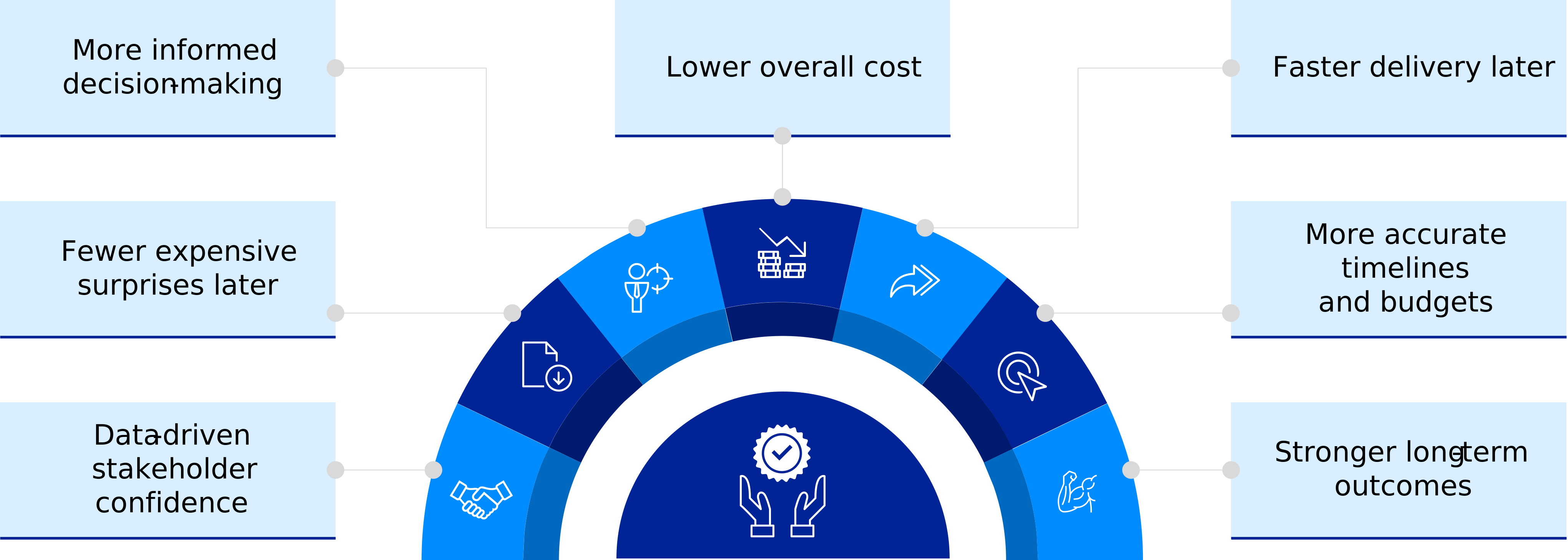
As promising molecules progress through development, flexibility decreases. Once a lead candidate has been selected, major investments have been made and IND-enabling activities are underway; opportunities to change course become more limited. Immunogenicity assessment remains valuable, but the resulting data may have fewer decisions to influence. For this reason, many developers are moving toward earlier and more iterative pre-clinical immunogenicity risk assessment strategies. The goal is to generate the right data at the point where it can provide the greatest value. Early insight can help teams compare candidates, identify liabilities, prioritize mitigation approaches and make more informed go/no-go decisions before major milestones are reached.
By generating pre-clinical immunogenicity insights before key development decisions are locked in, organizations can approach candidate selection and development planning with greater confidence. In a competitive bispecific landscape, that confidence can be a meaningful advantage.
How Lonza helps developers generate actionable insights earlier
Across the industry, developers are seeking ways to generate clearer insight earlier in development, before key milestones are reached, major investments are committed and programs advance toward IND-enabling activities. As immunogenicity becomes a more important consideration during candidate selection, understanding risk in isolation is often not enough. Developers need insight that helps place immunogenicity findings in the context of broader development priorities and candidate-selection decisions.
A broad immunogenicity risk assessment can also have a very direct impact on drug safety for future patients, so we are motivated to work hard to leverage our scientific and technical knowledge to mitigate uncertainty and improve manufacturing confidence early for our customers and their patients. Through our work as part of the Early Development Services (EDS) teams, we seek to help developers build a more complete understanding of immunogenicity risk by connecting molecular, mechanistic and product-quality considerations and enable them to generate data-driven insights that can ultimately support candidate selection, risk mitigation and development strategy decision-making.
Over the last years, as biologic modalities have become increasingly complex, we have seen how immunogenicity is becoming an important part of the broader candidate-evaluation process. Generating the right insight at the right stage can help teams better understand trade-offs, compare candidates more effectively and make development decisions with greater confidence. Before advancing a bispecific candidate toward IND, speak with our Early Development Services team to explore how early immunogenicity risk assessment can support more informed development decisions.
About the author:
Bruno Nolasco earned his MD from the National Autonomous University of Mexico and completed a post-doctoral fellowship at the Massachusetts General Hospital’s Center for Transplantation Sciences, where he studied mechanisms of allograft rejection and tolerance. He later joined Flagship Pioneering’s Generate Biomedicines, contributing to the development of the company’s pre-clinical immunogenicity risk assessment workflows. In 2024, he joined Lonza as part of the Immunology group, where he now supports the pre-clinical developability and immuno-safety portfolio within the Early Development Services division in Cambridge, Massachusetts. The Immunology group works across multiple business units to advance immunology programs for therapeutic proteins/peptides, mRNA therapies, vaccines, and cell & gene therapies. The team also provides support for regulatory filings, including the design and execution of studies for IND and ANDA submissions.
|
|
Need support with your early immunogenicity assessment?Early immunogenicity insight can help you compare candidates, identify potential liabilities and build more confidence into your development plan. Reach out to Lonza’s Early Development Services team to discuss how we can support your program before key decisions are locked in. |

 |