
The biopharmaceutical market continued to expand in 2025 and is expected to achieve a compound annual growth rate (CAGR) in the low teens over the next five years 1. A key subsegment within this space is antibody therapeutics, which currently accounts for approximately 50% of the total biopharmaceutical market, underscoring its strategic importance and continued growth potential 2. Historically, the biologics clinical pipeline has increased by approximately 9% per annum over the last ten years 3.
The mammalian and drug product CDMO market segments continue to show positive growth, with a CAGR expected in the low to mid-teens over the next five years 4. CDMO capacity continues to outpace capacity in customer-owned facilities, as large and small players increasingly rely on manufacturing partners to support, complement and de-risk their journey to market. Partnering models help attract customers by enabling capital preservation, direct access to leading expertise, de-risked supply, and regulatory support.
Large pharmaceutical organizations continue to contribute the majority of CDMO revenues due to commercial manufacturing activity. Small biotech businesses represent a higher proportion of the molecule pipeline, where outsourcing is built into business models to conserve capital resources. While funding has affected this segment in the short term, we expect this to normalize in the medium term.
Continued growth is evident across all phases of molecules in the biologics pipeline. This growth is supported by the increasing diversity of the pre-clinical and clinical molecule pipelines, including new biologics drug types and novel indications.
In 2025, venture capital (VC) funding in the biopharmaceutical industry remained selective amid tighter financial conditions and ongoing geopolitical and macroeconomic uncertainty, alongside growing competition from emerging sectors such as artificial intelligence (AI). Biotech VC funding remains available but is increasingly concentrated in fewer, larger rounds, reflecting a shift toward later-stage or de-risked opportunities. Looking ahead, funding is expected to stabilize or modestly rebound as interest rates ease. Our early-stage business continues to show a high level of utilization with good visibility. As these activities represent approximately 10% of our CDMO business, fluctuations in biotech funding are expected to have only a limited impact on our future performance.
Manufacturing demand in mammalian is expected to grow, supported by an expanding clinical pipeline and increasing demand for existing commercial mammalian-derived therapies. This growth is particularly evident in high-volume oncology and anti-inflammatory products, many of which serve multiple indications and large patient populations. Antibody-drug conjugates (ADCs) represent a fast-growing segment within mammalian drug types, with global drug sales projected to grow at above 20% CAGR over the next five years 5. To manage complexity and mitigate risk, customers increasingly seek CDMOs that cover the entire ADC value chain across modalities. In this market context, our robust offering available at each step of the molecule lifecycle enables customers to efficiently advance their therapies from development through to commercial launch.
Fill–finish manufacturing remains a key area for outsourcing, both among small and mid-sized biotech firms that often lack in-house manufacturing facilities and seek to avoid high capital investment and pharma companies with inhouse capabilities to secure robust redundant supply. The rise of complex modalities such as ADCs has increased demand for specialized fill–finish capabilities. Advanced technologies such as lyophilization and cytotoxic containment require expert handling and infrastructure, reinforcing the role of experienced CDMOs. Prefilled formats are gaining momentum, growing at approximately twice the rate of traditional vials, which reflects a shift toward patient-centric care and home administration. These trends reinforce the value of experienced CDMOs that can offer flexible capabilities across diverse delivery platforms. Integrated offerings are also emerging as a critical differentiator, with drug sponsors increasingly favoring CDMOs that can support the entire development and manufacturing value chain.
2025 – 2030 CAGR in USD ; Source: Evaluate Pharma (Biotechnology).
2025 – 2030 CAGR in USD; Source: Evaluate Pharma (Biotechnology).
Source : Citeline Biologics trends (excl. CGT).
2025 – 2030 CAGR in USD (Mammalian and Drug Product); Source: Frost & Sullivan (2025)
2025 – 2030 CAGR in USD; Source: Evaluate Pharma 2025 (Antibody drug conjugates)
pre-clinical and clinical large molecules1
commercial large molecules1
Including mammalian, microbial, bioconjugates, drug product and cell and gene therapy products (early development services are included for pre-clinical molecules only).
We have one of the most complete offerings across technologies and scales, alongside a wide range of services including regulatory support. Our customers range from small biotech to large pharmaceutical companies, and we deliver tailored services that meet specific customer needs. We support customers throughout the molecule lifecycle – from lead optimization, to pre-clinical, clinical and commercial phases, including Biologics License Application (BLA) support services. Across Integrated Biologics, we bring deep and long-standing expertise in commercial delivery with rigorous standards of quality, safety, efficiency and value.
Mammalian
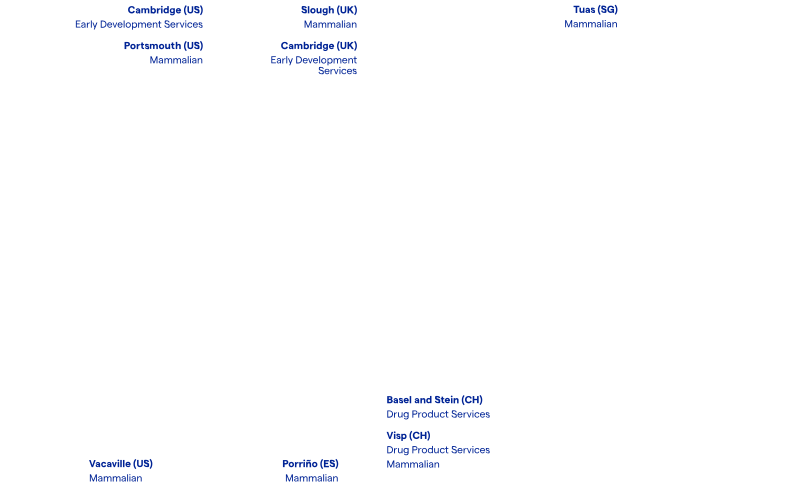
Our largest network – spanning scales, capabilities, technologies and geographies – lies in our Mammalian Technology Platform. We continue to see a healthy number of new molecules entering our pipeline across all phases. Several late-phase clinical molecules are set to reach the commercial stage in the short term, driving demand for large-scale manufacturing and supporting our future growth. The ongoing trend toward outsourcing, combined with increased demand for existing molecules and a growing number of molecules advancing toward commercialization, presents a sustained market opportunity in the coming years.
We are continuing to strengthen our robust pipeline by maintaining a strong focus on lifecycle management and integrated solutions with Drug Product and Bioconjugates. We remain committed to offering a full spectrum of mammalian development and manufacturing services across all molecule types. We will continue to invest in innovation to accelerate early development and help enable our customers to achieve their target cost of goods sold (COGS), while maintaining reliability and quality of commercial supply.
In 2025, we ramped up our new 20,000L asset in Visp (CH) to support customers seeking large-scale manufacturing. The site now consolidates demand across stages at a single site, from clinical development to launch and scale-up, with 1,000L, 2,000L and 20,000L bioreactors. This development further strengthens our global large-scale network, which has operations in Spain, Singapore, Portsmouth (US) and Vacaville (US), enhancing our ability to deliver reliable, scalable manufacturing solutions to customers worldwide.
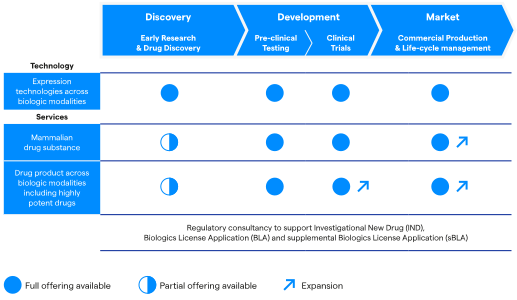
Our Drug Product Technology Platform provides fully integrated, phase-appropriate solutions to biologic drug product development and manufacturing, spanning formulation, process design, and primary packaging. We continue to see increasing demand for these integrated offerings, as customers seek to simplify and de-risk their supply chains through strategic partnerships with a single CDMO. Our approach enables our customers to address challenges across formulation, analytical, process development, and drug product manufacturing in order to bring high-quality drug products to market. In the last five years, we have expanded from drug product development services into clinical and commercial fill and finish, strengthening our ability to support customers across the product lifecycle.
Our DP portfolio includes expertise in drug product injection and infusion, covering parenteral administration routes including intravenous, subcutaneous and intravitreal. Our integrated approach spans diverse biologics modalities, from standard monoclonal antibodies to complex formats such as bispecific antibodies, fusion proteins, recombinant proteins, and bioconjugates including ADCs. Following Swissmedic approval for our new aseptic drug product filling line in Stein (CH) in October 2025, we can support our customers with filling services for highly potent molecules.
Our Licensing business manages access to our licensable Intellectual Property (IP), enabling companies to leverage proven technologies for development of new therapeutics. We support pharmaceutical and biotechnology companies, as well as research institutions conducting early research. Through strategic partnerships, we drive innovation by enabling both emerging start-ups and established industry leaders to benefit from Lonza’s industrial expertise and global reach.
Our evolving IP offering spans multiple therapeutic modalities and is built upon decades of continual innovation. At its core is our GS® mammalian gene expression system, a cornerstone in biologics manufacturing and a key component of our comprehensive suite of expression technology solutions. Today, we serve more than 400 active licensing customers who hold more than 190 research evaluation agreements. More than 100 approved therapeutics contain Lonza’s out-licensed IP, reaching millions of patients each year.


The Integrated Biologics Business Platform continued to deliver solid performance in 2025, driven by strong commercial demand and robust operational execution across its network. Growth in the Mammalian portfolio remained a key momentum driver, supported by both commercial and clinical small scale programs alongside maturing long term growth projects. Drug Product also demonstrated resilient growth, reflecting increasing customer demand and strengthening delivery capabilities.
Across the Integrated Biologics network, contracting volumes remained high, underscoring sustained market interest and the Business Platform’s strategic position in end‑to‑end biologics development and manufacturing.
Comparison vs. Prior Year
Sales (CHF)
CORE EBITDA (CHF)
CORE EBITDA Margin
Sales growth, expressed as a percentage (%), are at constant exchange rate (CER).
To support growing global demand for biologics and enhance our service offerings, we continued to expand and upgrade key facilities within our Integrated Biologics network in 2025.
In Visp (CH), our large-scale 20,000L expansion achieved successful initial GMP runs. In Portsmouth (US), our new 2,000L asset produced its first Process Performance Qualification (PPQ) batches, demonstrating that the asset’s defined process consistently delivers product that meets required quality, safety, and regulatory standards. A further expansion of this asset adds two additional 2,000L bioreactors and an additional downstream area. The expansion was initiated in early 2025 and is advancing according to plan.
In Stein (CH), we continued to make progress with the multi-purpose commercial fill and finish facility, with additional scope added for ADC filling and lyophilization. In October, the site also received full Swissmedic approval for an aseptic drug product filling line, supporting customers with clinical and commercial supply across biologics modalities including monoclonal antibodies, bispecific antibodies, and ADCs. This expansion strengthens our existing capacity for liquid and lyophilized vial filling, while introducing advanced containment technology for the safe manufacture of highly potent biologics.

Head of Integrated Biologics
In 2025, we enhanced our drug development and manufacturing offering. We upgraded our facilities in Visp, Portsmouth and Stein and achieved strong commercial momentum through operational excellence. We also continued to integrate Vacaville into our global network. These developments reflect our continuing dedication to turning breakthrough innovations into viable therapies for our customers and their patients.

Vacaville (US) is one of the world’s largest biologics manufacturing facilities, and is one of the most versatile sites in our portfolio, reinforcing our strategic footprint in the US for late-stage clinical and commercial supply. With more than 956,000 square feet of operational space across ten buildings, the site offers a total bioreactor capacity of around 330,000 liters. Since joining our global mammalian manufacturing network in October 2024, Vacaville’s integration into Lonza has progressed in line with plan. In 2025, the site delivered strong and consistent operational execution, maintaining its excellent quality track record while advancing preparations for new product introductions.
The site comprises both mid-scale (12,000L) and large-scale (25,000L) bioreactors, enabling flexible, multi-product campaign manufacturing. Supported by diverse capabilities and a customer-centric approach, the site is well positioned to meet growing market demand while delivering operational excellence and sustainable growth. Customer interest in the facility remained strong in 2025, with several customer contracts signed, multiple customer negotiations ongoing and further signings expected in the year ahead. The first phase of capital expenditure is progressing as planned, with additional investments to follow in the next two to three years to upgrade the site’s automation system and multi-purpose capabilities.
One of our key innovation focus areas in 2025 has been around advancing Host Cell Protein (HCP) analytics to enhance biopharmaceutical safety, process efficiency, and regulatory compliance. HCPs are critical process-related impurities that, even at trace levels, can compromise drug efficacy, stability, and patient safety. Their presence in processes may require re-engineering of purification steps, potentially impacting development timelines and manufacturing efficiency.
To address this challenge, we have developed a holistic HCP analysis platform that enables both quantitative and qualitative detection of HCPs. This allows us to detect previously undetectable impurities that could pose risks to patients. By combining advanced mass spectrometry with high-resolution data analytics, the platform delivers deeper insights into impurity profiles and supports the design of more targeted purification strategies. By understanding the identity and behavior of individual HCPs, purification processes can be tailored to reduce impurity levels and mitigate associated risks. This approach supports safer process development, particularly for novel and complex biologic molecules, where standard purification approaches may fall short.
These advances that improve our Gene to Clinic offering reflect a continued focus on improving biomanufacturing reliability and maintaining development timelines. With a more comprehensive understanding of HCPs, process engineers can make informed decisions earlier in development, helping to ensure the delivery of high-quality therapeutics.
Discover More

